
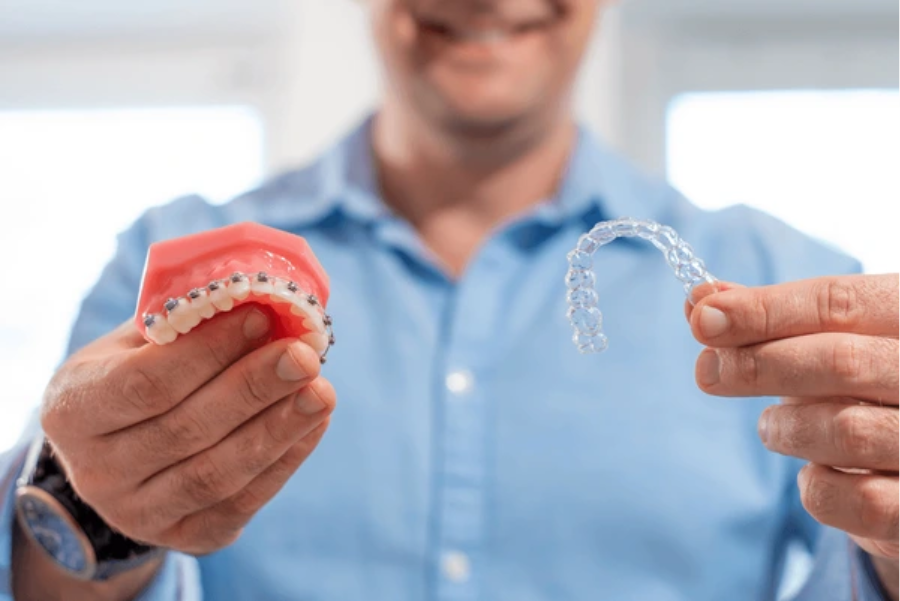
Before the invention of clear aligners, we were used to going to the dentist and getting metallic braces placed on our teeth to align them. However now that we have the option for clear, comfortable & removable clear aligners the popularity of metal braces has gone down. Both alignment options are equally effective in aligning teeth. Today you have a choice to make between aligners and braces. We hope to make this choice easier by giving you information about both the treatment options. Let’s discuss their pros and cons and their cost so that it will help you decide.
Braces: The start of aligning teeth
Metallic braces have been correcting smiles for many years. It was the best way to align teeth in a controlled fashion. They consist of metal brackets and a wire which connects them all. These brackets are fixed on the teeth with the help of dental composite. Regular appointments are scheduled for patients on a monthly basis to check on the braces and make adjustments as needed. These braces are fixed on teeth for a period of 1-2 years depending on the complexity of treatment. The teeth must be cleaned thoroughly in order to make sure no cavities happen during the treatment period. The brackets could cause ulceration and discomfort at the start. Patients also take a while to adjust to them. Painkillers may be given after activation appointments to make the unease less. Hard and sticky food items have to be avoided and even biting with the front teeth is restricted. They are clearly visible when the patient smiles or talks. The speech and chewing efficiency may decrease at the start of treatment but patients eventually get used to it. Along with brushing you may need an interproximal brush to clean between the braces. Elastics and other appliances may be added to the treatment if needed. However, braces can correct even complex cases and since they cannot be removed by the patient they are completely under the control of the dentist.
Aligners: The modern way of aligning teeth
Clear aligners are now in great demand in the dental market. They are clear and barely visible when the patient smiles or speaks. They are light, flexible and very comfortable to wear. They basically consist of transparent trays made of a superior grade plastic material. This material is safe for use in the mouth and does not cause any allergic reactions. The aligners are made based on the digital impression taken and a pre-approved plan which is shown and discussed with the patient. They are worn in sets which are changed approximately every 2 weeks. They must be worn for 20-22 hours daily. They can be removed while eating meals and brushing your teeth. The patient is thus in control of the treatment. The dental visits are also much less as compared to braces. The teeth may feel some pressure as you shift from one aligner set to the next.
Treatment with aligners can be done to correct minor to moderate malocclusions. For very complex cases they may not be advised. If not worn properly the treatment may get delayed. When not in the mouth they must be kept in an aligner case. They must not be exposed to hot substances as this may change their shape. Any refinements needed can be added by your dentist to the treatment plan. If all goes as follows you will have a well aligned smile in the pre-determined time period.
Pros and Cons of Aligners VS Braces:
| Topic | Aligners – Pros | Aligners – Cons | Braces – Pros | Braces – Cons |
| Appearance | Barely visible | none | none | Distinctly visible |
| Comfort | Light & comfortable | none | none | Mild discomfort after appointments |
| Treatment Duration | 1-1.5 Yrs | none | 1-1.5 yrs | none |
| Effectiveness | Good for mild and moderate cases | none | Good results in all cases | none |
| Maintenance & Cleaning | Easy | none | none | Difficult to keep clean |
| Eating Restrictions | No dietary restrictions | none | none | Restriction on eating hard & sticky foods |
| Cost | none | Expensive | Affordable | none |
| Frequency of Appointments | Few appointments needed | none | none | Monthly appointments |
| Suitability for Complex Cases | Not Suitable | none | Suitable | none |
| Digital Guidance | Present | none | none | Absent |
To Conclude
Even though we have highlighted all the facts about braces and aligners above you must ask your dentist what the best option would be in your case. Only after a dental examination can one know for sure what option would work best in their mouth. If budget is an issue, then braces may be opted for. Aligners are on the slightly expensive side. Most dental clinics do offer feasible payment plans to help budget your treatment as well. Find out all the details before making a decision. Let your dentist have the last word as they know what will work in the most effective way to make you achieve the smile you have dreamt of.